The Species
| 
Ammospermophilus leucurus
(antelope ground squirrel)
Class: Mammalia Order: Rodentia, Sciuromorpha
Body mass: 110 g Body temperature: 36.7°C
Circadian period: 24.3 h 
| 
Armadillidium vulgare (pill bug)
Class: Crustacea Order: Isopoda
Body mass: 40 mg Body temperature: N/A
Circadian period: 24.5 h
| 
Arvicanthis niloticus (Nile grass rat)
Class: Mammalia Order: Rodentia, Myomorpha
Body mass: 100 g Body temperature: 37.2°C
Circadian period: 23.8 h
| 
Atta sexdens (sauba ant)
Class: Insecta Order: Hymenoptera
Body mass: 20 mg Body temperature: N/A
Circadian period: unknown
| 
Bos taurus (cattle)
Class: Mammalia Order: Artiodactyla
Body mass: 800 kg Body temperature: 38.0°C
Circadian period: unknown
| 
Callithrix jacchus (marmoset)
Class: Mammalia Order: Primates, Anthropoidea
Body mass: 400 g Body temperature: 37.5°C
Circadian period: 23.7 h
| 
Camelus dromedarius (camel)
Class: Mammalia Order: Artiodactyla
Body mass: 500 kg Body temperature: 37.4°C
Circadian period: 24.5 h
| 
Canis familiaris (dog)
Class: Mammalia Order: Carnivora
Body mass: 30 kg Body temperature: 39.0°C
Circadian period: 24.4 h
| 
Capra hircus (goat)
Class: Mammalia Order: Artiodactyla
Body mass: 40 kg Body temperature: 39.0°C
Circadian period: unknown
| 
Carassius auratus (goldfish)
Class: Pisces, Osteichthyes Order: Cyprinidae
Body mass: 10 g Body temperature: N/A
Circadian period: 24.6 h
| 
Cricetus cricetus (European hamster)
Class: Mammalia Order: Rodentia, Myomorpha
Body mass: 450 g Body temperature: 37.4°C
Circadian period: 23.9 h
| 
Dryomys laniger (woolly dormouse)
Class: Mammalia Order: Rodentia, Sciuromorpha
Body mass: 30 g Body temperature: 36.4°C
Circadian period: unknown
| 
Equus asinus (donkey)
Class: Mammalia Order: Perissodactyla
Body mass: 400 kg Body temperature: 38.7°C
Circadian period: unknown
| 
Equus caballus (horse)
Class: Mammalia Order: Perissodactyla
Body mass: 700 kg Body temperature: 38.3°C
Circadian period: 24.2 h
| 
Gekko gecko (gecko lizard)
Class: Reptilia Order: Squamata, Sauria
Body mass: 30 g Body temperature: N/A
Circadian period: 23.4 h
| 
Glaucomys volans (flying squirrel)
Class: Mammalia Order: Rodentia, Sciuromorpha
Body mass: 70 g Body temperature: 36.9°C
Circadian period: 23.7 h
| 
Homo sapiens (human)
Class: Mammalia Order: Primates, Anthropoidea
Body mass: 70 kg Body temperature: 37.0°C
Circadian period: 24.6 h
| 
Ictidomys tridecemlineatus
(13-lined ground squirrel)
Class: Mammalia Order: Rodentia, Sciuromorpha
Body mass: 170 g Body temperature: 36.7°C
Circadian period: 25 h
| 
Melopsittacus undulatus (parakeet)
Class: Aves Order: Psittaci
Body mass: 50 g Body temperature: 40.0°C
Circadian period: unknown
| 
Meriones unguiculatus (Mongolian gerbil)
Class: Mammalia Order: Rodentia, Myomorpha
Body mass: 60 g Body temperature: 37.5°C
Circadian period: 24.2 h
| 
Mesocricetus auratus (Syrian hamster)
Class: Mammalia Order: Rodentia, Myomorpha
Body mass: 160 g Body temperature: 36.6°C
Circadian period: 24.1 h 
| 
Mus musculus (house mouse)
Class: Mammalia Order: Rodentia, Myomorpha
Body mass: 30 g Body temperature: 36.9°C
Circadian period: 23.6 h
| 
Mus terricolor (Indian pigmy field mouse)
Class: Mammalia Order: Rodentia, Myomorpha
Body mass: 10 g Body temperature: 36.3°C
Circadian period: 23.6 h
| 
Octodon degus (degu)
Class: Mammalia Order: Rodentia, Caviomorpha
Body mass: 240 g Body temperature: 36.8°C
Circadian period: 23.5 h
| 
Oryctolagus cuniculus (rabbit)
Class: Mammalia Order: Lagomorpha
Body mass: 3 kg Body temperature: 38.6°C
Circadian period: 23.9 h
| 
Ovis aries (sheep)
Class: Mammalia Order: Artiodactyla
Body mass: 40 kg Body temperature: 39.3°C
Circadian period: 23.8 h
| 
Pachyuromys duprasi (fat-tailed gerbil)
Class: Mammalia Order: Rodentia, Myomorpha
Body mass: 90 g Body temperature: 36.5°C
Circadian period: unknown
| 
Panthera leo (lion)
Class: Mammalia Order: Carnivora
Body mass: 160 kg Body temperature: 38.3°C
Circadian period: unknown
| 
Phodopus sungorus (Siberian hamster)
Class: Mammalia Order: Rodentia, Myomorpha
Body mass: 40 g Body temperature: 36.6°C
Circadian period: 24.9 h
| 
Pseudopidorus fasciata (Zygenid moth)
Class: Insecta Order: Lepidoptera
Body mass: 170 mg Body temperature: N/A
Circadian period: unkown
| 
Rattus norvegicus (rat)
Class: Mammalia Order: Rodentia, Myomorpha
Body mass: 400 g Body temperature: 37.3°C
Circadian period: 24.2 h
| 
Sciurus carolinensis (gray squirrel)
Class: Mammalia Order: Rodentia, Sciuromorpha
Body mass: 500 g Body temperature: 37.3°C
Circadian period: unknown
| 
Sciurus niger (fox squirrel)
Class: Mammalia Order: Rodentia, Sciuromorpha
Body mass: 800 g Body temperature: 37.3°C
Circadian period: unknown
| 
Spermophilus xanthoprymnus
(Anatolian ground squirrel)
Class: Mammalia Order: Rodentia, Sciuromorpha
Body mass: 160 g Body temperature: 37.1°C
Circadian period: unknown
| 
Tamias striatus (Eastern chipmunk)
Class: Mammalia Order: Rodentia, Sciuromorpha
Body mass: 100 g Body temperature: 36.7°C
Circadian period: 24.9 h
| 
Tupaia belangeri (tree shrew)
Class: Mammalia Order: Scandentia
Body mass: 190 g Body temperature: 37.3°C
Circadian period: 24.7 h
| 
Urocitellus richardsonii
(Richardson's ground squirrel)
Class: Mammalia Order: Rodentia, Sciuromorpha
Body mass: 600 g Body temperature: 36.2°C
Circadian period: unknown
|
|
|
Notes
|
A variety of vertebrate and invertebrate animal species has been used
in research in the lab. All the species used so far are
listed here.
Posted values of body mass, body temperature, and circadian period are
means only. Since some species exhibit more variability than others, the accuracy of
the posted values is variable. Most values were measured in our lab, but
some were obtained from the scientific literature. (Body temperature values for
ectothermic animals are indicated as N/A, meaning "not applicable".)
Samples of data obtained from individuals of some of these species are available
in the Data Repository section of this
web site.
Links to abstracts or full-text articles describing the
research that involved these animals in our lab can be found in the
Research and
Publications sections.
|
|

|
Highlight
|
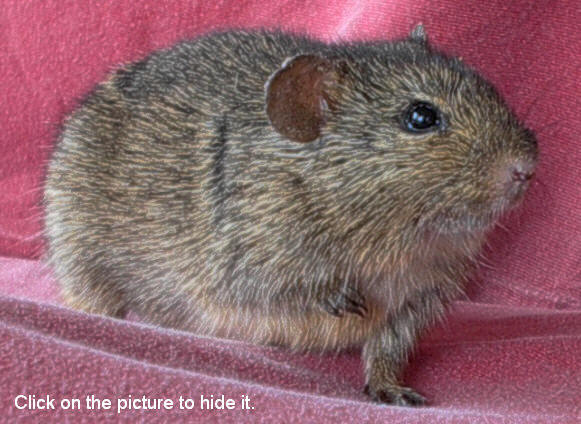
The Nile Grass Rat
As a diurnal rodent of small body size, good tempera- ment, and short breeding cycle, the
Nile grass rat ( Arvicanthis niloticus) is an attractive laboratory animal for biomedical
research. Like the standard laboratory rat, it is relatively insensitive to variations in
photoperiod and does not hibernate. Unlike the laboratory rat, it reaches asymptotic
body mass early in life and does not exhibit marked sexual dimorphism.
The genus Arvicanthis, traditionally believed to contain five species including A. niloticus,
belongs to the family Muridae, the large rodent family that includes the domestic mouse
( Mus), the laboratory rat ( Rattus), the hamster ( Cricetus and
Mesocricetus), and other rat-like rodents. The exact number of species within the
genus Arvicanthis is still under debate.
The Nile grass rat, sometimes also called African grass rat, unstriped grass mouse, or Kuzu rat, is a chunky
rodent with coarse, grayish brown fur. Adult head and body length is approximately 13 cm,
tail length is 10 cm, and body weight in captivity is 120 g. Females are slightly (6 g)
lighter than males. The species' natural geographic distribution is restricted to the northern
half of Africa, particularly the Nile Delta of Egypt, and to the southwestern Arabian
Peninsula, where it inhabits mostly grasslands and savannahs but also forests and scrubby
thickets. Regular use of nests or burrows, particularly at night, has been observed both
in the wild and under semi-natural laboratory conditions.
In temperament, the Nile grass rat is slightly more agitated than a laboratory rat but
considerably more sedate than a squirrel. When group-housed from weaning, it can be easily
handled as an adult. Single-housed individuals tend to become hostile towards conspecifics
and aversive to human handling. In the wild, Nile grass rats form social groups with several
adult males and females. Longevity has been reported to be as long as 6 years for healthy
individuals, although in our colony most animals have not lived past 2 years of age.
Laboratory colonies of Nile grass rats in North America are descendant of 29 individuals
trapped at the Masai Mara National Reserve in southwestern Kenya in 1993 by the research team
headed by Professor Laura Smale at Michigan State University. The species breeds easily in
captivity, particularly if provided with plenty of bedding and a small refuge (such as
a hollow PVC pipe) in the cage. The ideal ambient temperature is 20-25 °C, and a
short photoperiod (L11:D13) is recommended for proper gonadal function. Gestation
lasts 23 days on average, and a new pregnancy can be initiated within a few hours of delivery
of the previous litter if the male breeder is kept in the same cage as the female. Litter size
varies from 5 to 9 pups. The pups are born with fur and can be weaned by 21 days of age.
Infanticide and killing of the female by the male are occasionally observed, perhaps with a
frequency higher than that encountered in the breeding of standard laboratory rats and mice,
but they can be minimized by close monitoring of the breeding pairs.

|
|
Animal Research Ethics
|
Much of biomedical research is conducted with non-human animal subjects. Although a small
fraction of this research is directed at improvements in veterinary care, the major goal
is to improve human health. Experimentation with living organisms
is performed in animals for the benefit of humankind.
The conduct of research with animals is strictly regulated in most of the world. In the United
States, the use of animals in research is regulated by the Department of Agriculture (USDA)
and, in all projects that receive federal funding, it must conform to detailed guidelines
set out by the Public Health Service. Intentional infliction of pain is extremely rare and
limited to research on the physiology of pain itself. Importantly, whether pain is expected
or not, every research project must be pre-approved by an ethics committee. The task of the
various Institutional Animal Care and Use Committees (IACUCs) is to decide, based on the
scientific and ethical values of the community, whether the discomfort caused to the animals
is justified by the expected benefits of the research project. Authorization to perform the
project is denied if the justification is unsatisfactory.
Excellent guidelines for the humane use of animals in research are published by
the Institute for Laboratory Animal Resources of the U.S. National Research Council:
Guide for the Care and Use of Laboratory Animals, Eighth Edition
(Washington, DC: National Academy Press, 2010).
A copy can be purchased at www.nap.edu (ISBN: 978-0-309-15400-0).
|
|
Q&A
|
Q: Specifically regarding circadian rhythms, Mr. Peter Freeman, a teacher at
Diss High School (in England), asks whether what is learned about the suprachiasmatic
nucleus (SCN) in golden hamsters is applicable to human beings.
A: The general anatomical and physiological features of hamsters and humans
are similar, but, of course, not identical. Learning that the SCN is the master circadian
pacemaker in hamsters does not guarantee that the SCN is the master circadian pacemaker
in humans. However, studies have been conducted in many other species also. For instance,
surgical destruction of the SCN has been shown to eliminate circadian rhythmicity in
lizards, birds, hamsters, rats, mice, and other rodents. SCN lesion also eliminated daily
rhythmicity of activity in rhesus monkeys and was associated with loss of rhythmicity in
a woman with a gunshot wound in the brain. Rhythmic expression of circadian "clock
genes" has been documented in living cells of insects, fishes, birds, rodents,
ruminants, and humans. Thus, although the details of operation may differ between the
hamster SCN and the human SCN, there is very strong evidence that the SCN is the master
circadian pacemaker in hamsters and other mammals, including humans.
|
|
|
 Contact us


 To enjoy this web site, please instruct your browser to accept scripts.
 Home
Home